
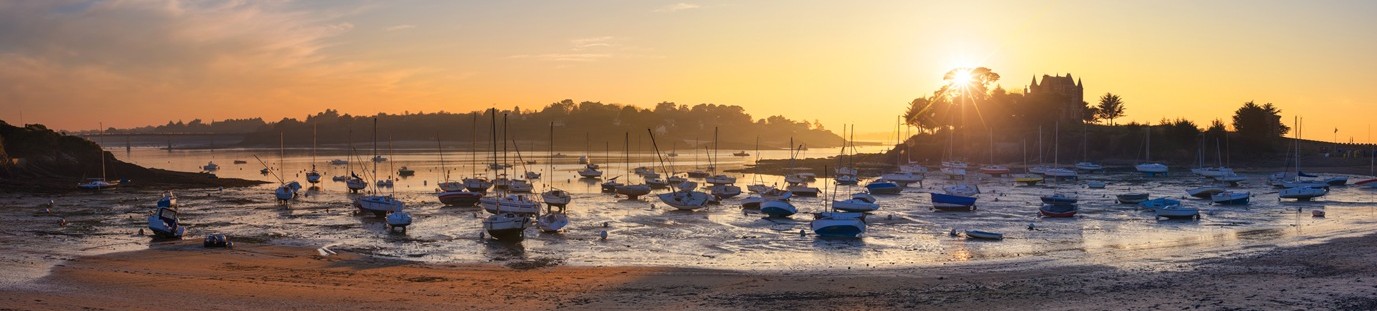
Saint-Briac-sur-Mer is located in Ille-et-Vilaine, Brittany, on the English Channel coastline, bordered to the west by the Frémur estuary. It enjoys an oceanic climate, with mild temperatures throughout the year. It is also an ideal destination for anyone looking for a beautiful property in Brittany.
From the monastery at the hamlet of La Chapelle to the seaside resort
According to tradition, two monks founded a monastery in the hamlet of La Chapelle, a haven of peace that is thought to be at the origin of the parish which bears the name of one of these men of faith. The first written mentions of the “parochia Sancti Briaci” appear in 13th‑century charters, and the commune only gained autonomy from the diocese of Aleth relatively late.
The fortified castle of La Houlle, built on the Nessay peninsula by the eponymous lordship, watched over the coastline and the Frémur estuary from the 12th century onwards.
In 1682, the Pontbriand family, originally from the fief of Saint-Lunaire, added to its possessions all the seigneurial jurisdictions of the parish: La Houlle, La Garde and La Ville-aux-Provôts.
Maritime activity expanded in the 18th century under the influence of the “Messieurs de Saint-Malo”. The inhabitants of Saint-Briac developed coastal trade, particularly between Le Croisic, La Rochelle and Bordeaux. Wines from Bordeaux and salt from the Bourgneuf Bay were at the heart of this activity, largely linked to that of the neighbouring port.
Fishing remained relatively marginal, and major merchants never settled there due to the impossibility of accommodating large-tonnage ships.
Despite the English raid at La Garde-Guérin in 1758, during which many houses were burned, the town’s prosperity was not fundamentally undermined and continued until the mid‑19th century.
The Belle Époque and the creation of the seaside resort
During the Belle Époque, as maritime activity began to decline, the new craze for sea bathing paved the way for the birth of a seaside resort.
In reality, it was in 1880 that this holiday destination truly emerged, driven by the local authorities who undertook to transform the fine sandy beaches into a small, family‑oriented seaside resort. Several emblematic buildings of that era have survived to this day: the Château du Nessay, built in 1886 and now a luxury hotel; the villas along the Boulevard de la Mer, constructed between 1880 and 1910; and the “Balcon d’Émeraude”, dating from 1929.
Prestigious guests contributed to the resort’s reputation, including the imperial family of the Tsar of Russia – Grand Duke Kyril, Grand Duchess Victoria Melita and their three children – who settled in the villa Ker Argonid on the Boulevard de la Mer to flee the Bolshevik Revolution. A stele in tribute to the Grand Duchess still stands there today.
The current property market in Saint-Briac
A discreet seaside resort on the Côte d’Émeraude, Saint-Briac has, over just a few decades, become one of the most sought‑after property markets in Ille‑et‑Vilaine. The transformation from a fishing village into an upmarket holiday destination has left a unique residential heritage: Belle Époque villas, manor houses overlooking the sea, renovated fishermen’s cottages, and apartments with views over bays and coves. This rare urban fabric, combined with carefully managed development, largely explains today’s strong pressure on supply.
The local market is now characterised by high price levels, limited inventory and strong demand from both year‑round residents and buyers of high‑end second homes. The most coveted properties lie in the emblematic sectors – around Nessay, the beaches of La Salinette and Le Perron, and the viewpoints over the offshore islets and Saint‑Malo – where the sea is omnipresent and architectural quality particularly high.
For buyers, investing in Saint‑Briac today means accepting prices in line with the resort’s prestige, but also benefiting from a truly patrimonial market: land scarcity, protected landscapes and the commune’s very strong image are long‑term assets for property values. Each transaction is therefore part of a broader patrimonial strategy rather than a simple real estate operation, and calls for a bespoke approach, attentive to micro‑locations, the history of the houses and the quality of their renovation.
If you are looking for a property in Saint‑Briac, contact us – we will be delighted to help you find the home of your dreams.