
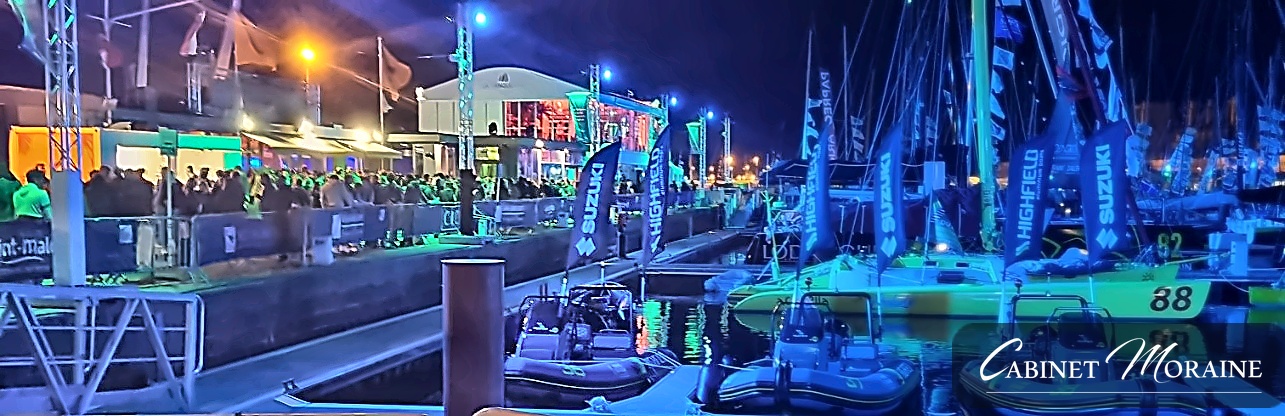
Saint-Malo at the heart of the sailing event of the year
Every four years, Saint-Malo becomes, for a few weeks, the world capital of solo sailing. In 2026, the city welcomes the 13th edition of the Route du Rhum – Destination Guadeloupe, with a fleet billed as one of the strongest in the race's history. For our agency, based in the heart of the Côte d'Émeraude, this event is far more than a sporting date on the calendar: it's also an opportunity to recall why so many families and investors choose Saint-Malo to live in or to own a second home.
Key dates to remember
The race village will open to the public in Saint-Malo from October 20 to November 1, 2026, with free admission. The grand départ is set for Sunday, November 1, 2026 at 1:02 pm, weather permitting. For nearly two weeks, the ramparts, the Môle des Noires and the quays of Saint-Malo will come alive with boats docked in the harbor, entertainment, and encounters with the skippers.
An exceptional fleet: 118 competitors, six classes
According to the latest available figures, 118 skippers are set to take the start, spread across six boat classes:
|
Class |
Number of boats |
Characteristics |
|---|---|---|
|
Ultim |
6 |
Flying maxi-trimarans of around 32 metres, the fastest in the fleet |
|
Ocean Fifty |
11 |
50-foot trimarans |
|
IMOCA |
26 |
60-foot foiling monohulls, including several Vendée Globe regulars |
|
Class40 |
49 |
40-foot monohulls, the most represented class |
|
Vintage Multi |
13 |
Traditional multihulls, including former ORMA trimarans |
|
Vintage Mono |
13 |
Period monohulls, in the original spirit of the race |
New this edition: the former "Rhum" classes have been renamed Vintage Multi and Vintage Mono, marked by the notable return of legendary ORMA trimarans. While this figure of 118 remains below the 2022 participation record (138 starters), the quality of the fleet is considered exceptional by race observers.
A legendary course all the way to Guadeloupe
The format stays true to legend: a solo transatlantic crossing, non-stop and without assistance, linking Saint-Malo to Pointe-à-Pitre over roughly 3,542 nautical miles, or nearly 6,560 kilometres. The event record belongs to Charles Caudrelier, 2022 winner aboard Maxi Edmond de Rothschild, in 6 days, 19 hours, 47 minutes and 25 seconds — becoming the first skipper to complete the course in under a week.
Favourites to watch
Among the Ultims, Charles Caudrelier defends his title aboard his new boat, Gitana 18, against formidable rivals: Armel Le Cléac'h (Maxi Banque Populaire XI), Thomas Coville (Sodebo Ultim 3), Tom Laperche (SVR-Lazartigue) and Anthony Marchand (Actual Ultim4). In the IMOCA class, Thomas Ruyant will defend his title against Jérémie Beyou, Sam Goodchild and Sébastien Simon, while Class40 — the largest fleet with 49 boats — will see skippers such as Ian Lipinski and Alexis Loison go head to head.
The history of the Route du Rhum
An idea born to save the rum industry
The story begins in 1975, when Bernard Hass, secretary general of the Antilles sugar and rum producers' union, was looking for an event to revive sales of Guadeloupean rum. He spoke to Florent de Kersauson (younger brother of Olivier de Kersauson), who suggested a transatlantic sailing race to the Antilles. The two men presented the project to Michel Etevenon, a Parisian advertising executive and showman, who initially turned it down.
The turning point of 1976
Everything changed in 1976 when the organisers of the Ostar (the "English Transat," the benchmark race since 1960) decided to cap boat size at 17 metres, sparking outrage among French sailors and architects who dreamed of larger multihulls. In response, Michel Etevenon announced in February 1977 the creation of a race with no restrictions whatsoever: the Route du Rhum, open to monohulls and multihulls alike, to professionals and amateurs alike.
Why Saint-Malo
Etevenon was quite literally in love with Saint-Malo, and he convinced local officials (including Jacques Guihard) that the race had to start from the walled city. The company Promovoile, which he founded with six other partners from the sugar and distillery trades, organised the event with the backing of three key partners: the city, the chamber of commerce, and the SNBSM.
The first departure, November 5, 1978
Immediately nicknamed the "Transat de la Liberté" ("Freedom Transat"), the first edition brought together 38 sailors, including Alain Colas, Bruno Peyron, Marc Pajot, Florence Arthaud, Olivier de Kersauson and Philippe Poupon (Eric Tabarly, though at the origin of the project, failed to secure funding in time). More than 100,000 people watched the start from Saint-Malo.
The race entered legend immediately, with a photo-finish after 23 days at sea: Mike Birch's trimaran Olympus Photo beat Michel Malinovsky's monohull Kriter V by just 98 seconds, on November 28, 1978. That edition was also marked by the tragic disappearance of Alain Colas and his trimaran Manureva off the Azores.
A race that has grown
Linking Saint-Malo to Pointe-à-Pitre in Guadeloupe over roughly 3,542 nautical miles (6,562 km), the Route du Rhum is held every four years, alternating with the Vendée Globe. After Michel Etevenon's death in 2001, Promovoile was taken over by Pen Duick, which has organised the race since 2006 under the name OC Sport Pen Duick. The current crossing record belongs to Charles Caudrelier, 2022 winner aboard Maxi Edmond de Rothschild (Ultime class), in 6 days, 19 hours, 47 minutes and 25 seconds.
Route du Rhum and real estate: a showcase effect for the Côte d'Émeraude
Beyond the sport, the Route du Rhum is a remarkable image booster for Saint-Malo. The city is regularly ranked among the "major sporting events" held in France, alongside the FIFA World Cup, the Tour de France or the Olympic Games. During a previous edition, a study commissioned by the city from the EY consultancy put the economic and tourism impact generated by the race village alone at 29 million euros. This worldwide media exposure, renewed every four years, helps sustain Saint-Malo's reputation and appeal well beyond its ramparts — it is also one of the drivers behind the steadily growing demand for real estate on the Côte d'Émeraude, whether for primary residences, second homes, or a life project turned toward the open sea.
Our Cabinet Moraine advice
If you are considering living or investing in Saint-Malo, Dinard or the Côte d'Émeraude, the Route du Rhum period is a wonderful moment to discover the city at its liveliest: take advantage of the village, open from October 20 to November 1, to explore the neighbourhoods that interest you, feel the atmosphere along the ramparts on grand départ day, and picture yourself in your future living environment. Our advisors are on hand to introduce you to our distinctive properties near the harbour and the beaches, before, during or after the race.
Contact Cabinet Moraine to discover our properties in Saint-Malo and on the Côte d'Émeraude for the 2026 Route du Rhum.
FAQ
When does the Route du Rhum 2026 start?
The start of the 13th edition is scheduled for Sunday, November 1, 2026 at 1:02 pm, from Saint-Malo, weather permitting.
When is the Route du Rhum village open to the public in Saint-Malo?
The village is open from October 20 to November 1, 2026, with free admission.
How many skippers are taking part in the Route du Rhum 2026?
118 skippers are set to compete, spread across six classes: Ultim, Ocean Fifty, IMOCA, Class40, Vintage Multi and Vintage Mono.
Where does the Route du Rhum 2026 finish?
The race links Saint-Malo to Pointe-à-Pitre, Guadeloupe, over roughly 3,542 nautical miles.