
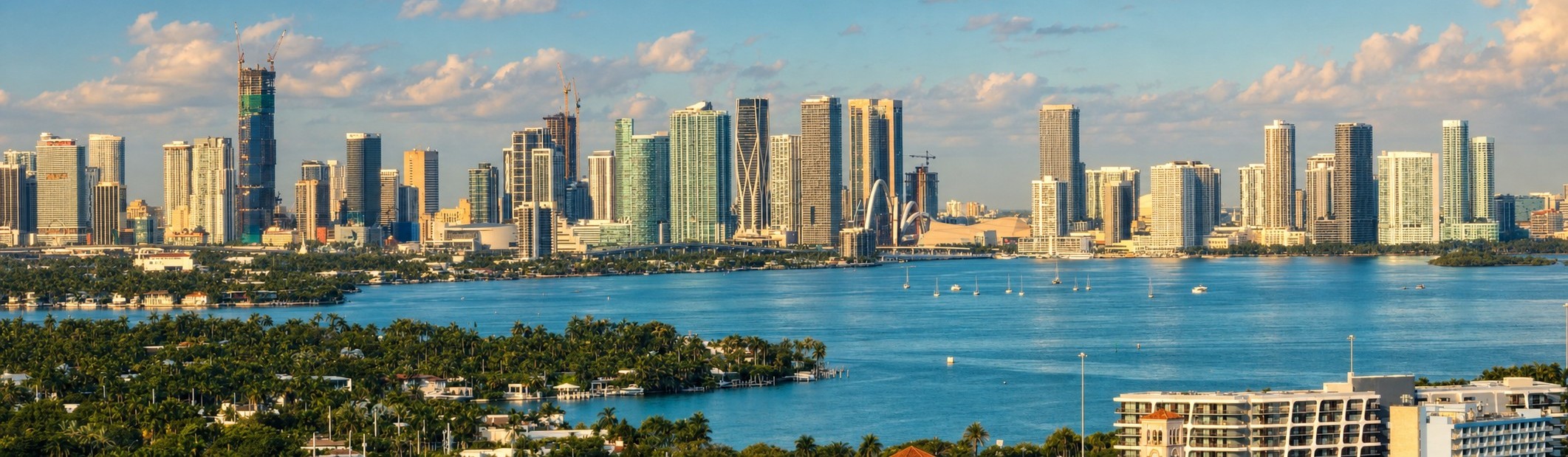
With year-round sunshine, no state income tax, a strategic position as a gateway between the Americas and Europe, and a booming economy, Miami remains one of the most sought-after real estate destinations in the United States. Whether you're looking for a primary residence, a sunny pied-à-terre, or a profitable rental investment, the greater Miami area (Miami Beach, Brickell, Coral Gables, Fort Lauderdale...) offers opportunities to fit nearly every budget and every life project.
This guide covers the state of the market in 2026, the neighborhoods to prioritize depending on your profile, the steps to buy as a foreign buyer, and the most effective investment strategies.
Why choose Miami to live or invest?
Several structural factors explain Miami's lasting appeal:
- Favorable taxation: Florida levies no state income tax on individuals, which appeals both to American residents relocating from higher-tax states and to foreign investors.
- An international hub: Miami is the natural gateway to Latin America, with a major international airport, one of the world's busiest cruise ports, and a strong presence of multinational companies.
- A sought-after lifestyle: over 300 days of sunshine a year, miles of beaches, a rich dining and cultural scene, and a year-round outdoor way of life.
- Structural rental demand: between tourists, young professionals, retirees, and newcomers from other US states or abroad, rental demand remains strong over the long run.
- No restrictions for foreign buyers: unlike many other countries, the United States requires no visa or special permit to purchase property in Florida.
The Miami real estate market in 2026: where do prices stand?
After several years of dramatic increases, Miami's market has entered a phase of rebalancing in favor of buyers. The 2026 figures from the leading platforms point to a clear trend:
- The median price of a property in Miami sits around $580,000 to $650,000, depending on the source and segment considered.
- Single-family homes are holding up well, with a median price close to $670,000, up roughly 3% year over year, driven by still-limited supply.
- Condos, a much more abundant segment, show more stable or even slightly softer prices, around a $420,000 median for Miami-Dade County.
- The average time on market has lengthened, to roughly 90-115 days compared with 75-100 days a year earlier, reflecting a less competitive market.
- Available inventory has grown significantly (more than 16,000 active listings across greater Miami), giving buyers more choice and more room to negotiate.
- The luxury segment ($1 million and above), by contrast, continues to perform well, driven by international demand and Miami's status as a global business hub.
The takeaway for a buyer or investor in 2026: the market is generally more favorable than it was in 2021-2022, with more choice, longer negotiation windows, and frequent discounts (around 5% under $400,000, up to 10% on properties above $1 million). It's an interesting window to enter the market ahead of an expected medium-term pickup in price growth.
The best Miami neighborhoods to live in or invest in
Miami officially has 47 neighborhoods, each with its own identity, buyer profile, and entry price point.
Brickell — the financial district
Often called the "Manhattan of the South," Brickell is packed with office towers, upscale residential high-rises, and a lively nightlife scene. It's the neighborhood of choice for young executives, expats, and finance professionals — ideal for a rental investment aimed at an executive tenant base.
Downtown Miami — the urban core in transformation
The cultural, commercial, and financial heart of South Florida, Downtown has benefited from more than 20,000 new housing units in recent years. A good balance between entry price and proximity to jobs.
Coral Gables, Coconut Grove, and Pinecrest — for families
This trio of leafy, quiet residential neighborhoods is the go-to choice for families relocating to Miami from other US cities or abroad. Excellent schools, a green setting, and a single-family home market more active than the condo market.
Miami Beach and South of Fifth — the beach lifestyle
Beaches, restaurants, luxury boutiques, and strong tourist demand make this a safe bet for short-term rentals, though prices are high and HOA fees can be substantial in historic Art Deco buildings.
Edgewater and Wynwood — the up-and-coming areas
Located between Downtown and the Upper Eastside, Edgewater is increasingly attracting investors thanks to new waterfront developments. Wynwood, a former industrial district turned arts and dining hub, appeals to a young, trend-driven crowd.
Aventura, Sunny Isles Beach, and Bal Harbour — the ultra-luxury segment
Highly prized by international buyers, these destinations combine high-end tourism with strong rental returns in the premium segment. Bal Harbour, in particular, posts some of the highest median prices in the region.
Doral and Kendall — the affordable alternative
For a more controlled budget while staying close to Miami, Doral and Kendall offer family homes at more accessible prices, with a large Spanish-speaking population and solid infrastructure.
Fort Lauderdale and West Palm Beach — the expanding surrounding areas
Less than an hour from Miami, these cities appeal with a more relaxed pace of life, sometimes softer prices, and strong potential for international investors seeking quality of life.
Living in Miami: what to know before you move
- Cost of living: higher than the US average, particularly for housing and insurance, but partly offset by the absence of state income tax.
- Climate and natural risks: very hot, humid summers and a hurricane season running from June to November. It's essential to check a property's flood zone status and homeowners insurance cost before buying.
- Transportation: Miami remains a car-oriented city, though central neighborhoods (Brickell, Downtown, Miami Beach) are becoming increasingly walkable and connected (the free Metromover, and Brightline rail service to Fort Lauderdale, West Palm Beach, and Orlando).
- Schools and healthcare: a good range of public and international private schools in family-friendly neighborhoods, and a high-quality healthcare system, though insurance coverage needs to be planned for.
- HOA fees: in condo buildings, fees can be steep, especially since building safety standards were tightened following the Champlain Towers collapse in Surfside. It's essential to check a condo association's financial reserves before buying.
Investing in Miami: the most common strategies
- Long-term rentals: the most stable strategy, supported by the region's continued population growth.
- Short-term / seasonal rentals: highly profitable in tourist areas (Miami Beach, Brickell, Downtown), provided you choose a building that allows this type of rental — not all condo associations do.
- Pre-construction purchases: staggered payments during construction and potential appreciation by the time of delivery, but with timeline and market risk to factor in.
- Multifamily properties: duplexes, triplexes, or small income properties, for steady cash flow and diversified tenant risk.
- 1031 exchange: a US tax mechanism allowing capital gains tax to be deferred by reinvesting sale proceeds into a new property — reserved for investors who already own property in the United States.
Buying in Miami as a foreign buyer: the key steps
The good news: no visa or residency status is required to buy property in Florida. The main steps are:
- Work with a local real estate agent to identify properties and negotiate.
- Open a US bank account (or arrange a secure international transfer) to complete the purchase.
- Expect stricter financing terms for non-residents: a down payment typically between 30% and 40% of the purchase price, plus cash reserves required to cover several months of taxes and expenses.
- Work with a US real estate attorney to structure the purchase (in your own name, through an LLC, or via a trust), particularly to optimize estate planning and tax outcomes.
- Budget for local taxes: annual property tax (roughly 1.5% to 2% of the property's value depending on the county), transfer taxes, and, where applicable, FIRPTA withholding tax that applies to foreign sellers upon resale.
Will Miami's real estate market keep declining in 2026? Forecasts for 2026 point more toward stabilization, or even a modest 2-4% recovery depending on the segment, supported by gradually easing mortgage rates and inventory levels that, for now, remain favorable to buyers.
What budget should I plan for a first purchase in Miami? Condos in mid-range neighborhoods start around $300,000-$400,000, while a single-family home in a sought-after family neighborhood generally requires a budget starting at $700,000-$800,000.
Is it profitable to rent out a property short-term in Miami? Yes, in tourist areas like Miami Beach or Brickell, but it's essential to check the condo association's rules and local municipal regulations, which vary significantly from one building and city to another.
Can buying real estate in Miami get you a visa? No, purchasing real estate alone does not grant any US visa. Some investors combine their real estate project with an investor visa (E-2 or EB-5), but these are separate processes that should be handled with an immigration attorney.
In 2026, Miami remains a stronghold of the US real estate market: a market rebalancing in buyers' favor, a wide diversity of neighborhoods to suit every profile — from families in Coral Gables to investors in Brickell — and a tax and legal framework that remains very open to international buyers. The key to success is the same everywhere: clearly define your project (residence, rental investment, medium-term appreciation), choose the right neighborhood based on that project, and surround yourself with trustworthy local professionals (real estate agent, attorney, tax advisor) before getting started.